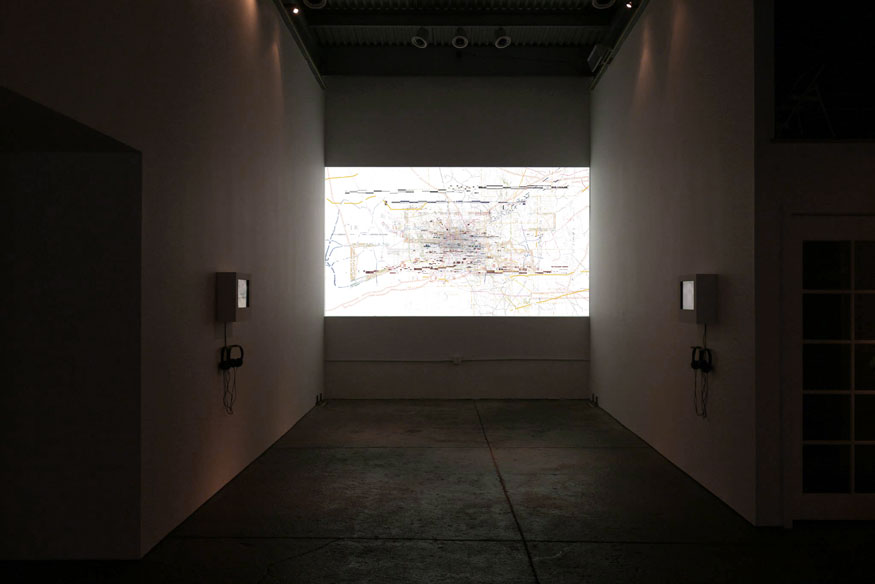
Terra Incognita was created out of a long-standing interest in how maps not only describe the world but also shape how we see and understand it—through the drawing of boundaries, the definition of territories, and the commodification of resources. Coming from a country shaped by a long history of colonialism and imperial expansion, I recognize that representations of the land are not neutral but part of that legacy.
I first began thinking about this around thirty years ago, before moving from the UK to the United States. A friend opened a road atlas of Illinois—the state I was moving to—and I was struck by its visual order: counties laid out in a rigid grid, entirely unlike the irregular boundaries I knew in England. It wasn’t just a visual difference; it revealed a different ideological system imprinted onto the land—one that has stayed with me.
A few years later after I settled in California, a colleague told me about the Public Land Survey System (1785), a coordinate-based method used to divide and record land parcels, creating townships of 36 square miles, plots of 640 acres, and subdivisions within that, eventually used across 1.5 billion acres of land, beyond the original thirteen colonies. That grid reflects Enlightenment logic: a Cartesian ordering of space, overlaid with little reference to geography or existing patterns of habitation—an abstract system of coordinates used to measure, divide, and quantify. Imposed onto the land, it disregards Indigenous settlement and flattens the complexities of terrain—rivers, hills, ecosystems—into a simplified structure. This mathematical perfection and clarity carried a kind of violence, facilitating territorial claims, land dispossession, and resource extraction, making them appear rational and justifiable.
Land is fundamental to how we live. Climate, resources, and our relationships with others within specific environments shape our bodies, knowledge, cultures, and sense of identity. We are not separate from the land—we are formed through it. Cultures with enduring, deep-rooted relationships to land understand that connection differently—as lived and relational, formed through ongoing interaction rather than imposed structures. The way land is mapped influences what is visible, valued, and known, as well as what can be extracted or erased. To structure land is also to structure thought, raising the question of how such imposed frameworks might be reconfigured or redrawn.
In Terra Incognita, I respond to these concepts by dismantling an American road atlas. Its pages are broken apart, glitched, and reassembled into unfamiliar configurations. The piece is created within a 3D virtual X,Y,Z Cartesian space, but one that undermines order rather than imposing it. Recognizable places and map symbols are disrupted, and extracted fragments form new visual topologies that resist easy reading.
Through the process of deconstructing the atlas, I became aware of how much history is embedded within it. The roadmap began to feel less like a tool for orientation and more like a document of human presence—marked by conflict, movement, and exchange—where meanings are densely layered and sometimes deliberately obscured. In making Terra Incognita I was drawn to this complexity, seeking through this artwork to reveal an uneasy beauty shaped by tragedy, loss, ambition, idealism, and survival.
Terra Incognita is structured as a palindrome, beginning and ending at the same point. This symmetry suggests the possibility of reversal—of colonial expansion, extractive systems, and their human and environmental consequences—opening space to consider how these histories and their impacts might be repaired or reimagined.
Through this act of “un-mapping,” Terra Incognita invites a way of seeing that allows for uncertainty and complexity, acknowledging the disquieting relationships between representation, history, land, and power.
Terra Incognita has been shown at New Art {Centre}, Reus, Spain, the Lamar Dodd School of Art at the University of Georgia, Aggregate Space in Oakland, WORK:Detroit, the California State University, Sacramento Faculty Show, and the Ars Electronica festival in Linz, Austria.